Before I watched “Little Women,” it always felt like nothing more than an overpraised classic that I would never connect to. Now I can say for certain that the story I have been deliberately ignorant of for many years has changed my life entirely.
In 1868, Lousia May Allcott created the incredible “Little Women”—a classic novel so far ahead of its time that, to this day, it still maintains relevancy to society. This American classic has been adapted multiple times in different eras ranging from 1900s to the 2000s, but the one that caught my attention was Greta Gerwig’s “Little Women” adaptation released in 2019.
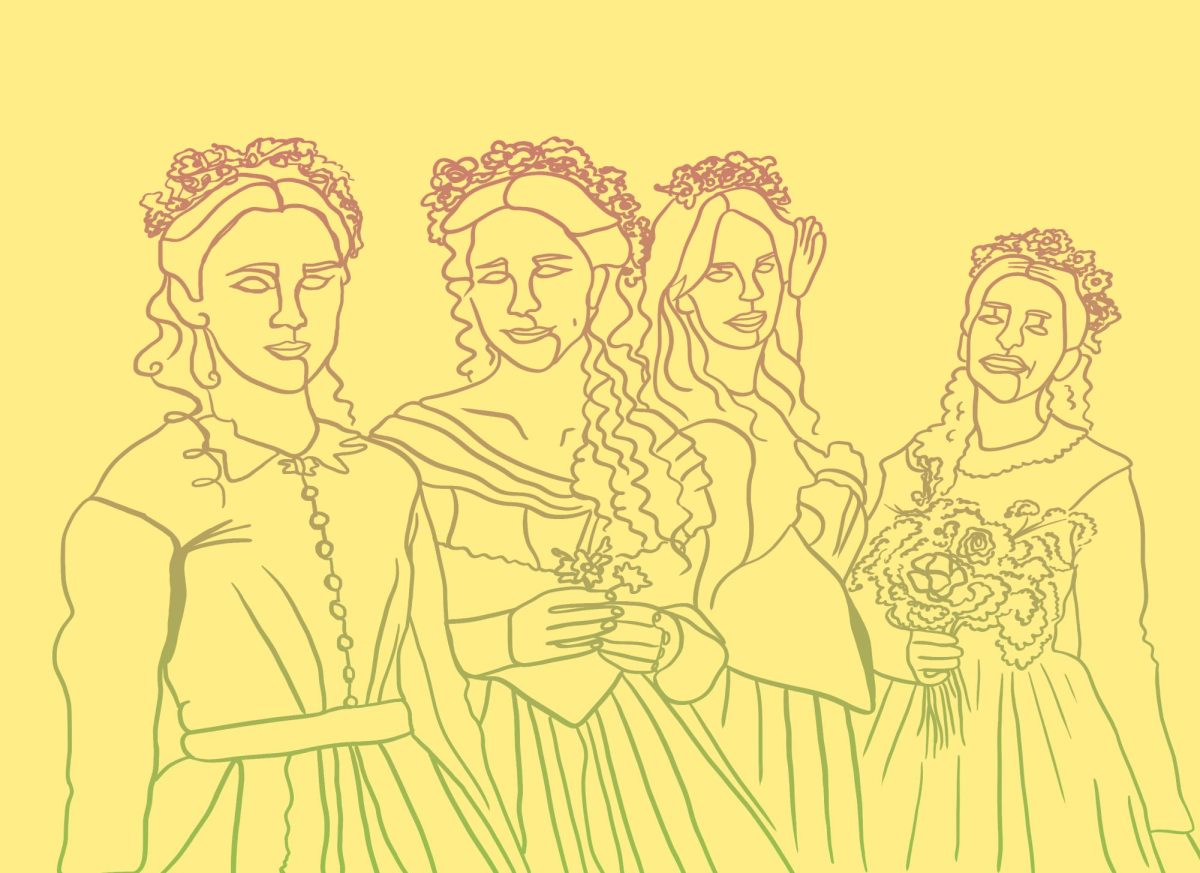
The movie “Little Women” follows the journey of the March Sisters: Jo (Saoirse Ronan), Amy (Florence Pugh), Meg (Emma Watson), and Beth (Eliza Scanlen), as they experience life together as young women growing up during the time period of the Civil War.
Gerwing’s adaptation of “Little Women” made me realize the beautiful story that I’ve been missing out on. The film’s cinematography brought golden tones to represent the manner in which children view the world with curiosity despite the darkness in the world at the time.
Throughout the film, Gerwing took the approach of flipping back and forth from the March sisters’ womanhood and their youth, encapsulating the feeling of growing up. Watching the transition between bright, warm tones during the girls' youth, into darker, lifeless tones as the girls grew into women perfectly demonstrates the loss of childhood naiveness.
In the past, women didn't have the same opportunities as men, causing the young women to suppress their passions and desires in order to conform to the societal standards of the time. Along with that, the interaction between each girl perfectly captures how sisters really interact.
Each sister’s aspirations vastly differ and require almost all of their attention, causing their family to no longer be a top priority. Although forever best friends, it is impossible to stay in constant contact, especially during this period of their lives.
Jo went off to New York to be an author, Meg chose to settle down and have children, Amy went to Paris to chase her dream of being a painter and then married her childhood crush, Laurie, while Beth stayed in her childhood home until her final days.
Having grown up with three sisters myself, this film is the epitome of growing up and splitting into our own lives. It is a different type of grief watching your siblings follow their own journeys while you are still trying to find your calling—this film encapsulated that feeling more than words could ever describe.
After talking to multiple people about the movie as a whole, many tended to lean towards talking about their love or hatred for the two most popular sisters, Jo and Amy. The other March sisters, Meg and Beth, although just as dynamic, tend to go completely unnoticed.
Meg, being the oldest sister, always tried to uphold the standards that society and her parents had set in order to be a good example for her younger siblings. She found comfort in living a quaint life. Acting was always only a hobby for her; she wanted to live a classic domestic lifestyle.
Jo pushed Meg to find something more in life, trying to explain that marriage would only set her back—especially marrying a man without riches. This is where she responds to Jo saying, “Just because my dreams are different from yours doesn't mean they are unimportant.”
Why was Meg’s dream not enough? She found fulfillment in the life she was building for herself, so what made her aspirations so frivolous in comparison? Could it possibly be because she fit into the boxes that society placed women in at the time?
Beth always noticed things that fell under the radar and gave love to those who were forgotten like her. Beth dedicated her time to the Hummuls, a family in much deeper poverty, by bringing food and offering to care for their young children. Then, she began providing Mr. Laurence (Chris Cooper) company by playing gentle piano music to liven up his empty home.
Mr. Laurence and Beth had a beautiful connection. Mr. Laurence saw his granddaughter–who unfortunately passed—through Beth, both sharing the similar timid yet caring attributes. Her precise observation of the world allowed her to understand everything on a deeper level; it pains me to know she will never get the recognition she deserves.
Beth always had the capability to do more, but her life was cut short due to illness. She was incredibly talented in piano and various crafts, yet that was never enough, and she was forgotten amongst her brighter siblings.
Amy will forever be fans' least favorite sister. Her personality and actions on the surface reflect a selfish, spoiled younger sister. However, those who see her that way simply don't understand her entirely.
Amy is a collection of all her sister's personalities wrapped into one: the poise of Meg, the stubbornness of Jo, and the understanding of Beth. Yet, the only thing that seems to stand out to viewers are her irritating comments and wants.
Amy wants to see the world, get married, and live the lavish life that all her siblings yearn for, and in following that journey, she gained the label of a bratty youngest sister. She spoke without thinking, acted rashly, and would be shoved aside for never being old enough to be involved in the activities that her older sisters would partake in.
Amy always got the leftovers and the most pressure to create something amazing with what she was given. After Laurie (Timothée Chalamet) got rejected by Jo after so many years, he fell in love with Amy instead. Although she finally would be with her childhood crush, it was impossible not to grieve the fact that once again, she got what was left over.
As years went on, Amy began flourishing into a mature young woman, but she would never be seen nor treated as an adult—she is forever stuck as the baby of the family and is to be treated as such.
For example, when Beth was about to pass, nobody informed Amy because her family believed she would not be able to handle such information while living a luxurious life away in Paris. Amy was never incapable of handling the heavier parts of life, but she was never allowed to catch up to the maturity that her older sisters had already reached far before her.
Then there is Jo, who always knew what she wanted and was ready to do anything and everything to get there. Her siblings always said that she was a “lost cause” since it was impossible to make her settle down instead of chasing her preposterous dreams.
Her goal was to defy all societal norms, and she did just that. When she wanted her writings published, Mr. Dashwood demanded for Jo’s works to reflect directly what the patriarchy wanted: “Tell her to make it short and spicy. And if the main character is a girl, make sure she's married by the end. Or dead, either way.”
She accepted the demand to an extent, but she negotiated for royalties on her books. It was all or nothing. With her drive, it was no surprise she got exactly what she desired. In this specific movie adaptation, Jo watches the creation of her book, all the nights she spent feverishly working away at creating an impressional novel finally becoming a reality.
Furthermore, Jo opened her own school. She witnessed first hand the struggles of trying to learn in an environment that neglects your education. Her dreams were never chimerical; those who doubted her simply couldn't understand the extent of what her work could do for the world.
Never before have I felt so moved by a movie; Gerwig deserves all the credit for creating an adaptation that encapsulates the emotion and themes of “Little Women” entirely. There are not enough words to describe the whole hearted adoration that I feel towards not only this movie adaptation, but the superb novel itself.
If you have yet to see this movie, you are missing out on not only a cinematic masterpiece, but a beautiful story. “Little Women” (2019) is available to watch most accessibly on Amazon Prime and Hulu.